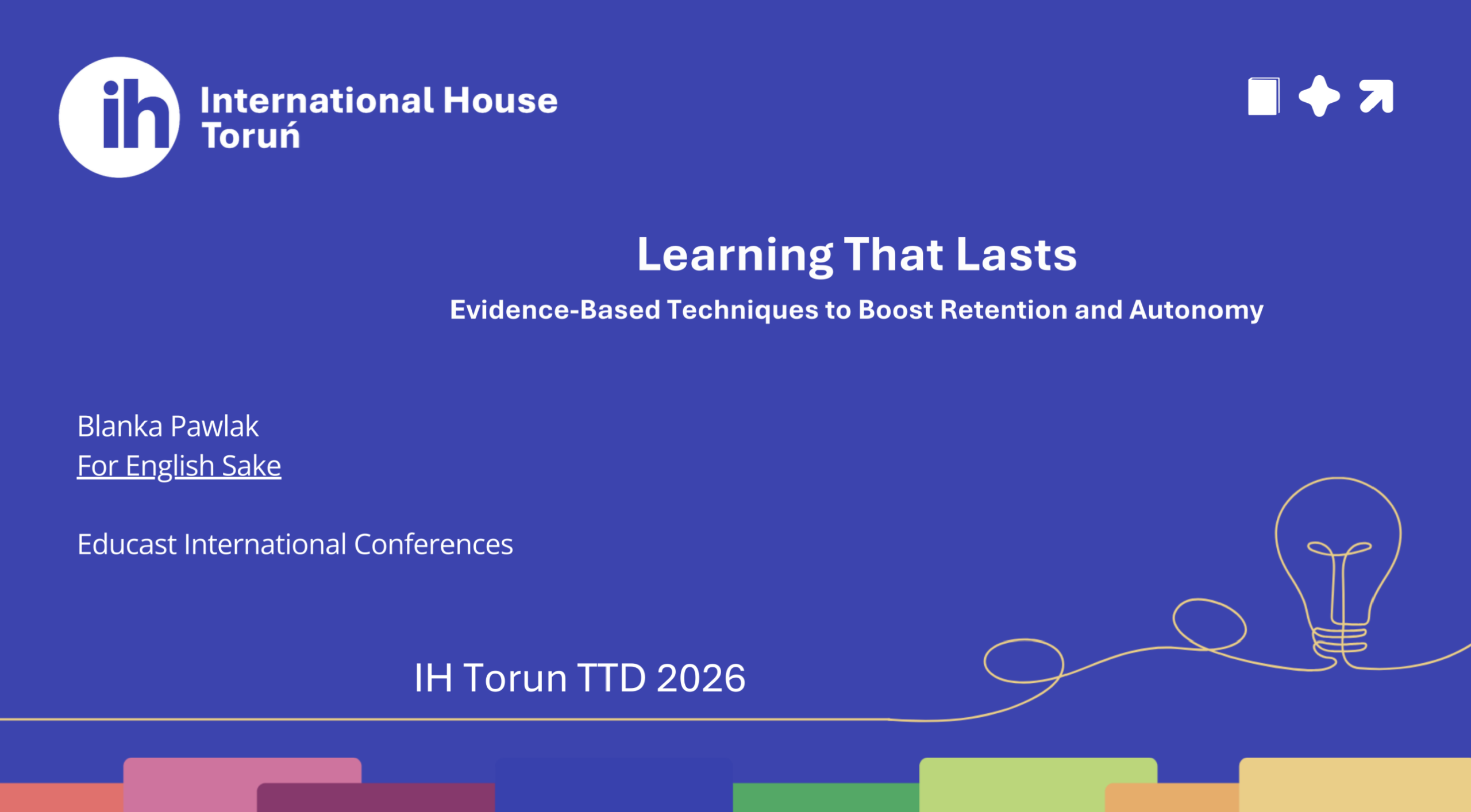
I prepared a workshop on memory, retrieval, and metacognition. I arrived with research, slides, and a taxonomy of cognitive tasks. I left with better questions than the ones I started with – and that, it turns out, is exactly the point.
The session covered the science of why students forget, how retrieval practice outperforms rereading, and what genuine reflection as opposed to the polite performance of it actually looks like in the classroom. We experienced the techniques as we discussed them:
a vocabulary illusion test, a live retrieval sprint, prompt surgery on weak questions.
The kind of learning that happens in the body, not just in the notes.
But here is what I did not fully anticipate.
It was the participants’ questions that did the real intellectual work.
Not the planned ones – the unplanned ones. The ones that don’t appear in any journal article because they come from someone standing in a real classroom, with real constraints, trying to do something genuinely difficult.
"But what if students don't want to struggle? What if ease is the only thing keeping them in the room?"
That question reframed a lot. Because the research on desirable difficulties is not an argument for unnecessary suffering, it is an argument for productive struggle. And the difference between those two things is almost entirely contextual. It all depends on the student, the subject, the relationship, the room. That nuance belongs in the conversation, not in the footnotes.
Another participant asked: “Is learner autonomy realistic when grades are everything?”
That is not a question about pedagogy. That is a question about power. About who owns the evaluation and what that ownership does to a learner’s relationship with their own intelligence. I have been sitting with it since.
A third: “What does retrieval practice look like when you have forty students and forty-five minutes?”
Exactly. The research lab and the classroom are not the same place.
Learning sciences give us a direction. Context tells us how far we can actually walk.
What I want to offer you here are not summaries of slides.
They are three practical tools – the ones I believe make the biggest difference, and the ones the room’s questions sharpened the most. Consider this the tip of the iceberg, with
an invitation to keep diving.
In this post I start with the first one you can use today.
The research on the testing effect is among the most replicated findings in cognitive psychology: trying to remember something strengthens memory more than reading it again. Not because struggle is virtuous, but because retrieval is itself a learning event – not a measure of one.
The smallest possible version of this looks like asking students to close their notes and write down everything they can recall before you reveal anything. Even three minutes of imperfect, incomplete retrieval outperforms ten minutes of rereading. The generation effect tells us that producing an answer – even a wrong one – makes the correct version stick harder when it finally arrives.
Try this prompt
Next posts will cover:
#2 Metacognition & Reflection
#3 Learner Autonomy & Design